Designing more sustainable products is no longer just an ethical – choice it is a strategic design and business decision.
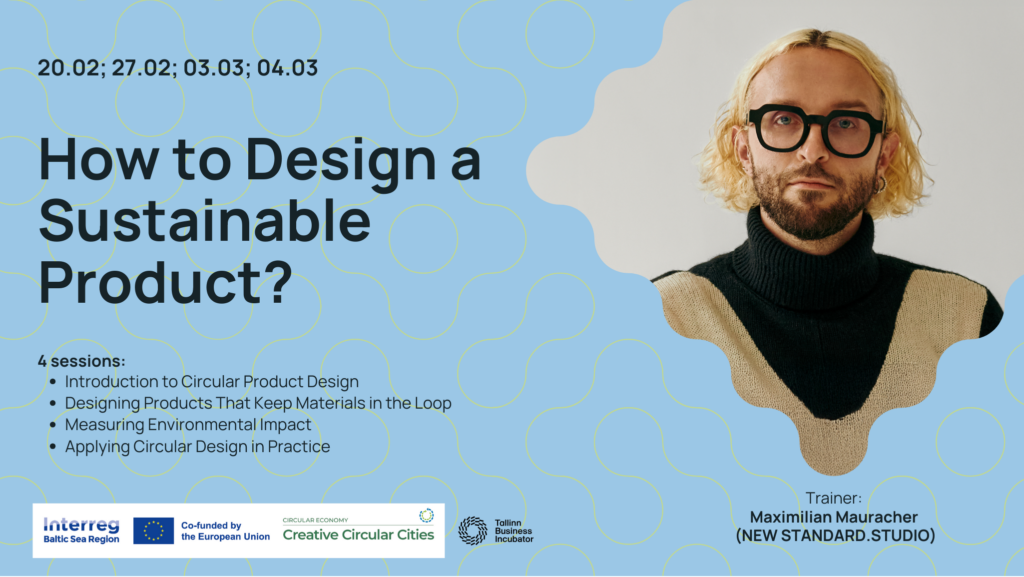
This four session course introduces circular product design as a practical and accessible design discipline, showing how circular principles can be translated into concrete product decisions across the full product lifecycle, from material choices to use and end-of-life.
Through short lectures, real-world examples, and hands-on exercises, you will gain the skills and confidence to design products that keep materials in use, reduce environmental impact, and create long-term value. The training provides practical tools and methods that can be applied directly to your own products or ideas, helping you move from intention to implementation.
20.02 at 14.00-17.00 EET: Introduction to Circular Product Design
The first session establishes the shift from linear to circular product systems and builds a shared conceptual foundation. You will learn the core principles of circular product design, examine common linear design pitfalls, and map product lifecycles to understand where value is lost, impacts are locked in, and design responsibility begins.
27.02 at 14.00-17.00 EET: Designing Products That Keep Materials in the Loop
This session moves from mindset to application by focusing on concrete design strategies such as durability, modularity, repair, reuse, and disassembly. It explores how material choices, construction methods, and waste streams shape product lifetimes and circular potential, and you will learn how to apply these strategies directly to existing or planned products.
03.03 at 13.00-16.00 EET: Measuring Environmental Impact
The third session reframes impact measurement as a design aid rather than a reporting obligation. You will learn the basics of lifecycle thinking, how to identify major environmental hotspots, and how simplified tools can support more informed and credible sustainability decisions.
04.03 at 13.00-16.00 EET: Applying Circular Design in Practice
The final session integrates principles, strategies, and measurement into real-world product development. Trade-offs and constraints are addressed, circular ambitions are translated into concrete design choices, and you will leave with a clear and realistic action plan for applying circular design in practice.
Trainer:

Maximilian Mauracher is an internationally awarded designer, strategist and creative leader in circular economy, sustainability, and design-driven transformation.
He studied at the University of Applied Arts Vienna and has spent over a decade working at the intersection of business, communication, and systems change with companies, cities, and organisations, including FREITAG, Decathlon, WWF, the city of Berlin, and many more.
As co-founder and managing director of Berlin-based NEW STANDARD.STUDIO, Maximilian works with international teams to translate complex sustainability challenges into clear strategies, products, services, and narratives. His work focuses on pragmatic innovation and strong storytelling – building solutions that are both economically viable and environmentally meaningful.
The event is FREE, but registration is requiered!
- Registration gives access to all four trainings!
All of the courses take place online! The link will be sent one day prior to the event!
This series is part of the CCC project incubation programme organised by Tallinn Business Incubator in spring, which aims to provide specialised training modules for the cultural and creative sectors focused on business development, internationalisation and the implementation of circular economy solutions.
In addition, the programme includes English-language series on How to Design a Sustainable Product?, How to Design a Sustainable Service?, Getting Ready for International Markets, Storytelling and Communication, and Estonian language series How to Present and Stand Out as an International Visual Artist.
The CCC incubation programme is intended for experts in the cultural and creative sectors, entrepreneurs and start-ups, designers, visual artists, students, and other interested participants.
The events are part of the Creative Circular Cities project, co-funded by the European Union’s Interreg Baltic Sea Region Programme 2021–2027. The project aims to support the transition to a circular economy at the local level by actively involving the cultural and creative sectors.